ATS resume checker for data analysts.
Data analyst resumes get screened out over vague tool mentions and analysis without outcomes: "worked with data" instead of the specific language and platforms, "built reports" instead of the decision they informed. JobForte cross-references your resume against the actual posting and shows you where that's happening.
Check your resume →What gets missed
The gaps ATS screens flag most on data analyst resumes.
- Named tools, not categories. "Data tools" doesn't match a posting that screens for "SQL" and "Tableau" by name.
- Statistical methods. A/B testing, regression, cohort analysis, forecasting: often practiced but described only as "data analysis" on the resume.
- Business impact over activity. "Built a dashboard" reads differently than "built a dashboard that cut reporting time 60% for the sales team" when a posting screens for measurable impact.
- Data scale and sources. Row counts, pipeline volume, and the specific data sources (product events, CRM, warehouse) a posting names directly.
- Stakeholder language. Postings that mention partnering with product, marketing, or finance screen for those words explicitly, not just "cross-functional work."
How screening works
Who reads an analyst resume, and what each one looks for.
The applicant tracking system comes first, and its main job is to make your resume searchable. Recruiters filter applicants by the tools in the posting, so a resume that says "reporting tools" instead of Power BI simply doesn't appear in a search for Power BI. Analyst postings are unusually tool-specific, which makes exact names matter more here than in most roles.
A recruiter reads next, quickly, checking the stack, years of experience, and domain. Domain matters more than many analysts expect: marketing analytics, product analytics, and financial analysis use overlapping tools but different vocabulary, and a recruiter will look for the words from their own team's posting.
The hiring manager, often an analytics lead, reads for judgment. They want to see that you chose a method for a reason, understood its limits, and that someone acted on what you found. Many analyst interviews also include a SQL exercise or take-home, so claim only the depth you can demonstrate. A bullet that names the tool, the method, and the decision it informed serves all three readers at once.
Before and after
Three analyst bullets, rewritten against a real requirement.
Each example starts from a requirement as it typically appears in a posting. The experience behind the bullet doesn't change, only how precisely it's described.
The posting asks forAdvanced SQL; experience with dbt and a cloud data warehouse
BeforePulled data from multiple sources to support reporting needs.
AfterWrote and maintained 40+ dbt models in Snowflake joining product events, billing, and CRM data, replacing manual weekly extracts for the finance and sales teams.
The posting names SQL, dbt, and a warehouse. The original bullet describes the same work without any of them, so a recruiter search for "dbt" skips it.
The posting asks forDesign and analyze A/B tests to inform product decisions
BeforeAnalyzed experiment results for the product team.
AfterDesigned and analyzed 12 A/B tests on the onboarding flow, including sample size and significance checks; the winning variant lifted 7-day activation from 31% to 36%.
"Analyzed experiment results" is activity. The rewrite shows you owned the design, understood the statistics, and that a product decision followed.
The posting asks forBuild self-serve dashboards in Tableau for non-technical stakeholders
BeforeCreated dashboards and reports for various teams.
AfterBuilt a Tableau dashboard suite for regional sales managers covering pipeline, win rate, and quota attainment, cutting ad hoc data requests to the analytics team by about half.
Naming the tool, the audience, and what changed afterward matches all three parts of the requirement instead of none.
Only claim numbers you can defend in an interview. If you don't have exact figures, an honest estimate ("about half," "roughly 2M rows a day") still beats no measure at all.
See it in action
A real analysis for a data analyst role.
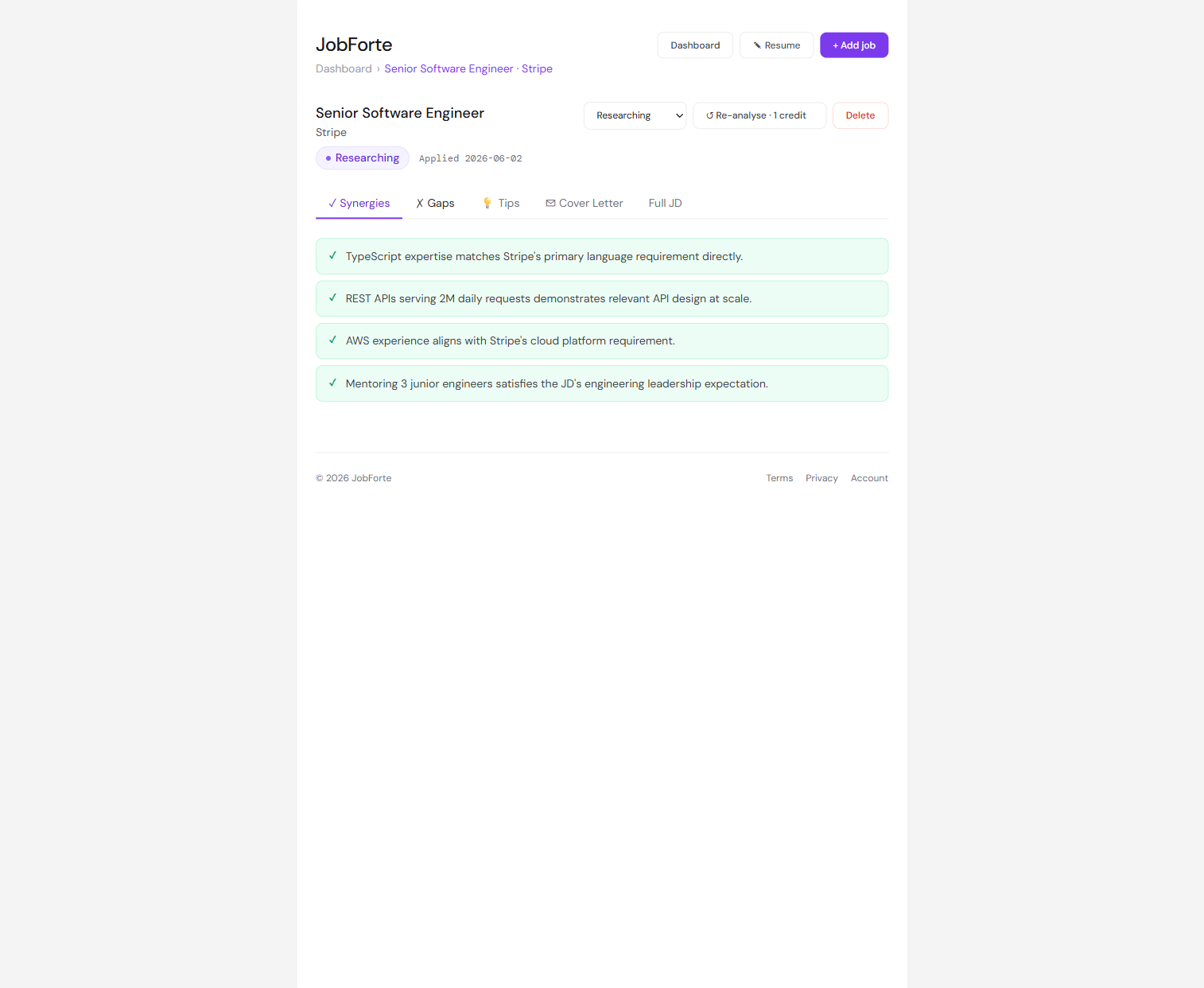
Synergies: where the resume already matches the job description, named specifically.
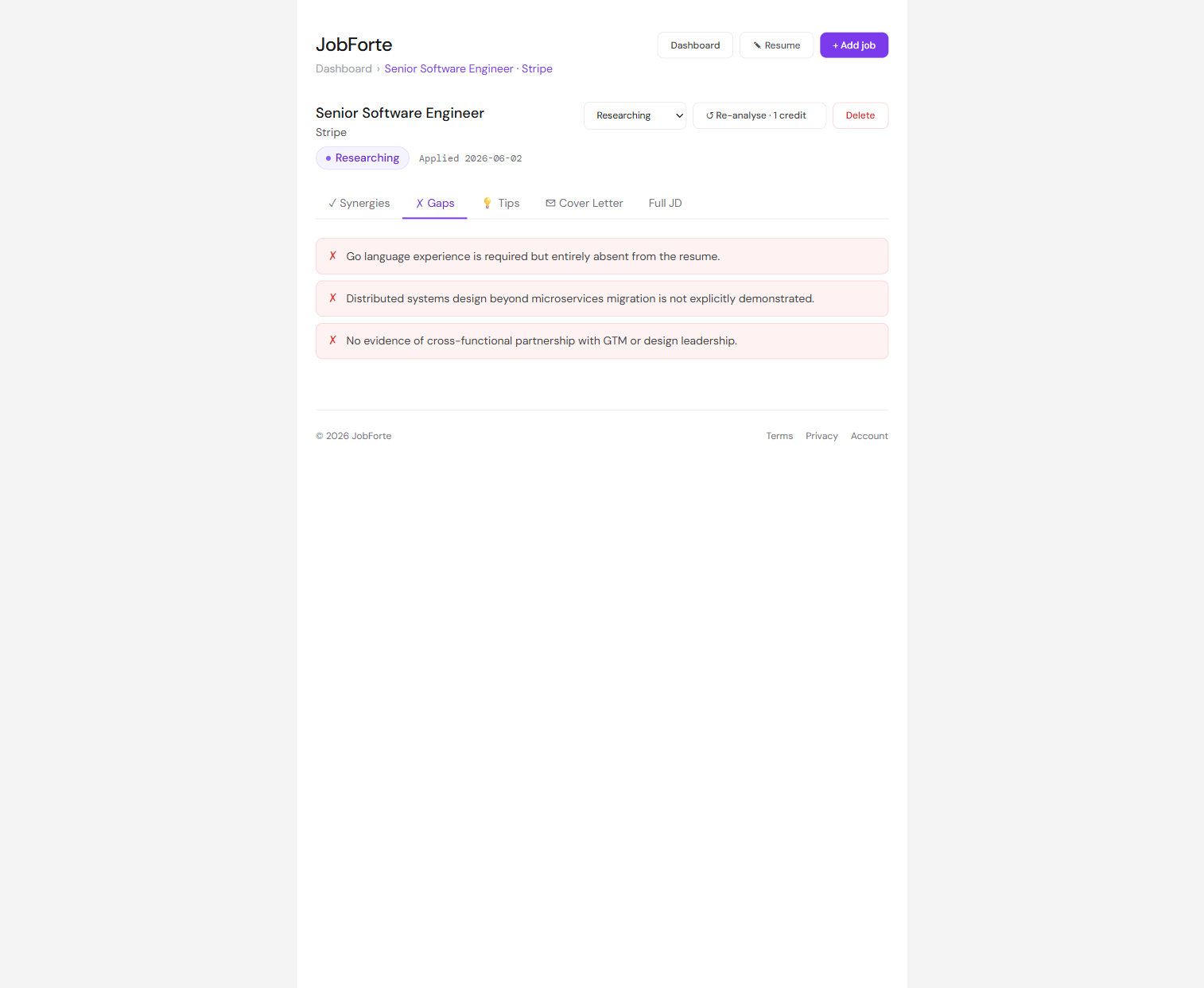
Gaps: what the posting asks for that the resume doesn't reflect yet, split from what's genuinely missing.
Questions
What ATS keywords do data analyst resumes need?
Screens tend to look for named tools (SQL, Python, Tableau, Power BI, Looker), specific techniques (A/B testing, regression, cohort analysis, forecasting), and the business impact of the analysis, not just "analyzed data" or "built dashboards." A resume that lists tools without the decision or metric an analysis drove is the most common gap.
How do I show data impact without a data science title?
Tie each analysis to a decision or outcome it drove: "built a churn model that informed a retention campaign, reducing churn 8%" reads very differently than "built a churn model." JobForte flags where a job description screens for business impact and your resume describes the analysis without the outcome.
Does this work for both SQL/Python-focused and BI-tool-focused analyst roles?
Yes. The analysis is generated from the specific job description you paste in, so a posting screening for Python and statistical modeling surfaces different gaps than one screening for dashboard ownership in Tableau or Looker.
Should I list Excel on a data analyst resume?
If the posting mentions it, yes, and be specific about what you do with it: pivot tables, Power Query, or financial models say more than 'advanced Excel.' Many analyst roles, especially in finance and operations, still run on spreadsheets. For a posting centred on SQL and a warehouse, Excel belongs in the skills list rather than leading your bullets.
Do I need a portfolio as a data analyst?
It helps most when your paid work doesn't show what the posting asks for, or when you're moving into analytics from another field. A short write-up of one or two projects, with the question, the data, the method, and what you concluded, is more useful to a hiring manager than a gallery of dashboards. Link it from your resume header so it's easy to find.
Other roles
Checking a resume for a different role?
One free credit included · Packs from $3.99 · No subscription