ATS resume checker for product managers.
PM resumes get screened out over missing outcomes: features listed without the metric they moved, roadmap work described as "involvement" instead of ownership. JobForte cross-references your resume against the actual posting and shows you where that's happening.
Check your resume →What gets missed
The gaps ATS screens flag most on PM resumes.
- Metrics without outcomes. "Shipped feature X" doesn't match a posting screening for measurable impact: the number and direction it moved matters.
- Ownership vs. involvement. "Worked on the roadmap" vs. "owned the roadmap for a $2M ARR product line" changes whether a screen for product leadership matches.
- Named stakeholders. Postings that mention cross-functional collaboration with engineering, design, sales, or support screen for those words explicitly.
- Process and methodology. Discovery, experimentation/A-B testing, prioritization frameworks (RICE, opportunity scoring): often practiced but unnamed on the resume.
- Business context. Company/team stage (0-to-1 vs. scaling an existing product) and market (B2B vs. B2C) that a posting screens for directly.
How screening works
Who reads a PM resume, and what each one looks for.
Product manager titles mean different things at different companies, so the applicant tracking system is mostly a search tool here. Recruiters filter the pool by the words in the posting: B2B or consumer, growth or platform, a domain like payments or healthcare, and tools such as Amplitude, Mixpanel, or Jira. A resume that never states its domain or product type can drop out of those searches even when the experience fits.
The recruiter screen comes next and is fast. Recruiters look for a clear level signal (associate, senior, group), a product the reader can picture, and evidence that you owned something rather than supported it. Words like "owned," "defined," and "led" carry weight; "assisted" and "participated" usually don't.
The hiring manager, typically a senior PM or head of product, reads for judgment. They want to see how you chose what to build, what you decided not to build, and whether the metrics you moved are the kind their team cares about. A strong PM resume gives each reader what they need: the right keywords for the search, clear ownership for the recruiter, and a decision plus an outcome in every bullet for the hiring manager.
Before and after
Three PM bullets, rewritten against a real requirement.
Each example starts from a requirement as it typically appears in a posting. The experience behind the bullet doesn't change, only how precisely it's described.
The posting asks forOwns product outcomes and defines success metrics for their area
BeforeManaged the roadmap for the mobile app and shipped several new features.
AfterOwned the mobile app roadmap (iOS and Android, 400K monthly users) and set its retention target; shipped saved searches and push reminders that lifted 30-day retention from 21% to 27%.
The posting screens for outcome ownership. The original lists output ("shipped several features") and never says what changed because of it.
The posting asks forStrong discovery skills and experience running experiments
BeforeWorked with users to understand their needs and improve the product.
AfterRan 24 customer interviews to find why trials stalled, then designed three A/B tests on the setup flow; the winning variant raised trial-to-paid conversion from 9% to 12%.
"Worked with users" matches neither discovery nor experimentation. The rewrite names both methods and shows the decision they led to.
The posting asks forLeads cross-functional teams across engineering, design, and go-to-market
BeforeCollaborated with various teams to launch the new pricing page.
AfterLed a team of 6 engineers and 2 designers through the pricing page relaunch, and aligned sales and support on the new packaging before launch.
Postings that name specific functions screen for those words. "Various teams" hides exactly the stakeholders the reader is looking for.
Only claim numbers you can defend in an interview. Hiring managers routinely ask how a metric was measured and what else changed at the same time, so be ready to explain the attribution behind every figure you list.
See it in action
A real analysis for a product manager role.
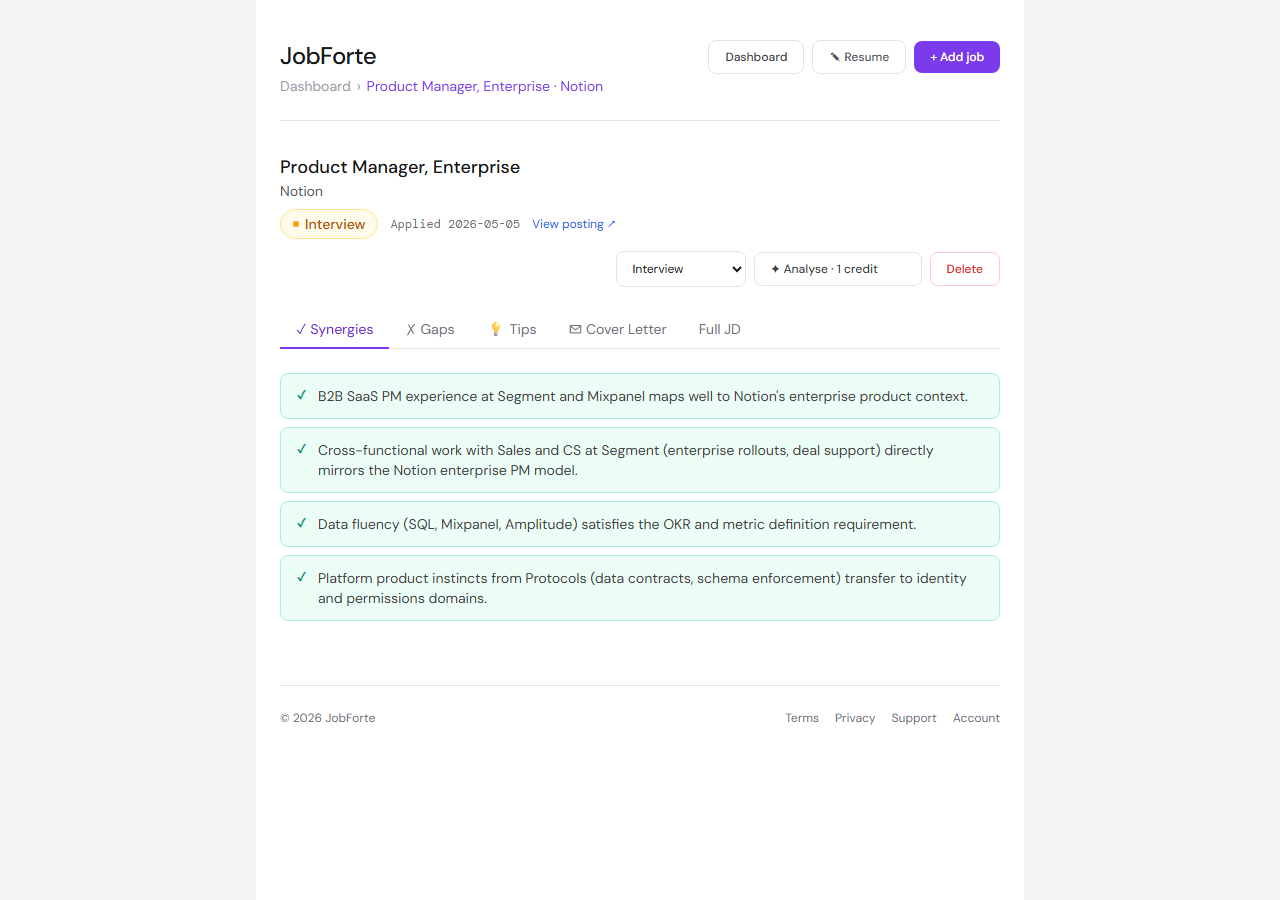
Synergies: where the resume already matches the job description, named specifically.
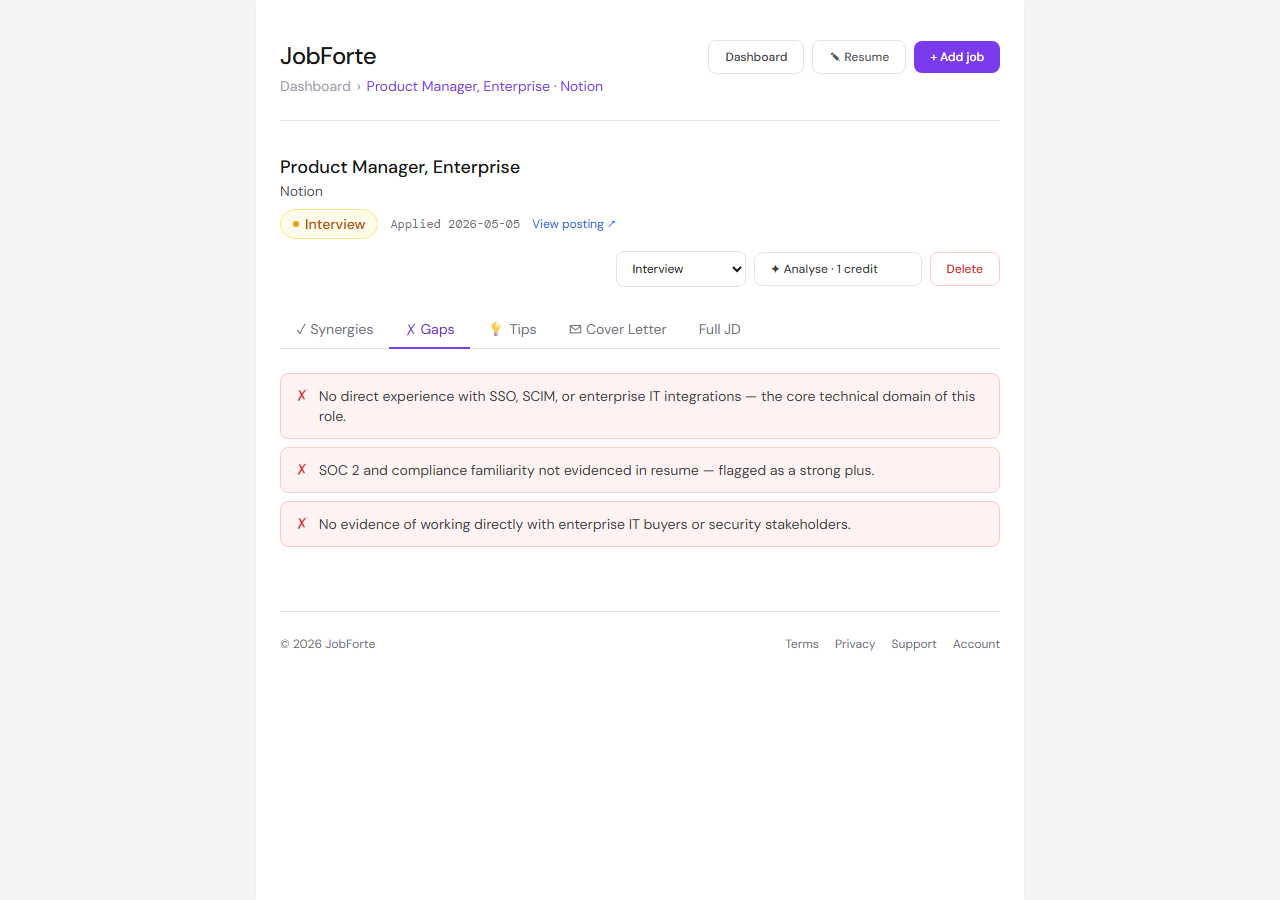
Gaps: what the posting asks for that the resume doesn't reflect yet, split from what's genuinely missing.
Questions
What ATS keywords do product manager resumes need?
PM screens tend to look for metrics ownership (the specific numbers you moved and by how much), roadmap language ("owned the roadmap" vs. "worked on features"), and named cross-functional stakeholders (engineering, design, sales, support). A resume that lists features shipped without the business outcome tied to them is the single most common gap.
How do I quantify product impact on my resume?
Tie each feature or initiative to a metric it moved: activation rate, retention, revenue, time-to-value, support ticket volume. "Shipped onboarding redesign" reads very differently than "redesigned onboarding, increasing activation 18%." JobForte flags where a job description screens for metric ownership and your resume describes output without outcome.
Does this work for both technical and growth PM roles?
Yes. The analysis is generated from the specific job description you paste in, so a technical PM posting screening for API design collaboration surfaces different gaps than a growth PM posting screening for experimentation velocity and funnel metrics.
What if I can't share exact product metrics from a previous employer?
Use relative numbers instead of absolute ones. "Increased weekly active users 22%" or "cut churn by a third" shows the outcome without exposing revenue or user counts your employer treats as confidential. If even percentages are off limits, describe the direction and the decision behind it ("reversed a two-quarter decline in retention") so the reader still sees that you owned a result, not just a release.
How do I move into product management from engineering, design, or another role?
Reframe the product work you already did rather than listing your old job duties. Most career switchers have written specs, run customer interviews, made scope trade-offs, or argued for a priority with data, but describe it in the language of their current title. Name those activities in PM terms (discovery, prioritization, requirements, launch) and tie each to an outcome, so a screen for product skills finds them.
Other roles
Checking a resume for a different role?
One free credit included · Packs from $3.99 · No subscription