ATS resume checker for software engineers.
Engineering resumes get screened out over specifics: the exact languages, frameworks, and scale a job description names that your resume doesn't. JobForte cross-references your resume against the actual posting and shows you where that's happening.
Check your resume →What gets missed
The gaps ATS screens flag most on engineering resumes.
- Named technologies, not categories. "Full-stack development" doesn't match a posting that screens for "React" and "Node.js" by name.
- System scale. "Built a payments service" reads differently than "built a payments service handling 40K transactions/day" when the posting asks for high-scale experience.
- Ownership language. "Contributed to the migration" vs. "led the migration" changes whether a screen for "technical leadership" matches at all.
- Infra and process keywords. CI/CD, on-call rotations, code review process, testing strategy (unit vs. integration vs. e2e): often true of the work but absent from the resume.
- Cloud platform specifics. "Cloud experience" vs. naming AWS, GCP, or Azure directly, plus the specific services used.
How screening works
Who reads an engineering resume, and in what order.
Most engineering applications pass through three readers before a technical interview. The applicant tracking system comes first, and it rarely rejects anyone by itself. What it does is make your resume searchable: recruiters filter the applicant pool by the technologies in the posting, and a resume that never names Kubernetes doesn't come back from a search for Kubernetes, no matter how much container work is behind it.
A recruiter reads next, usually for well under a minute. Recruiters are rarely engineers, so they match the words on the posting against the words on your resume: the named stack, years with it, and a level signal like "senior," "led," or "owned." Then the hiring manager reads for judgment: what you decided, what trade-offs you made, and whether the scale you worked at resembles theirs.
The practical upshot is that a strong engineering resume says the same true thing at three levels. It names the exact technology for the search, states your role plainly for the recruiter, and gives one number or trade-off per bullet for the hiring manager.
Before and after
Three engineering bullets, rewritten against a real requirement.
Each example starts from a requirement as it typically appears in a posting. The experience behind the bullet doesn't change, only how precisely it's described.
The posting asks forExperience designing and operating distributed systems at scale
BeforeWorked on backend services for the orders team.
AfterDesigned and operated the order-routing service (Go, Kafka, Postgres) processing 2M events/day at 99.95% uptime; cut p99 latency from 800ms to 120ms.
The posting screens for design and operation at scale. The original bullet names neither, and "worked on" reads as a supporting role.
The posting asks forStrong TypeScript and React; experience with frontend performance
BeforeBuilt new features for the customer dashboard using modern JavaScript frameworks.
AfterRebuilt the customer dashboard in React and TypeScript, splitting the bundle by route to cut initial load from 4.1s to 1.6s for 30K weekly users.
"Modern JavaScript frameworks" matches none of the three named requirements. The rewrite hits all of them with the same underlying work.
The posting asks forOwnership of CI/CD, testing strategy, and production on-call
BeforeHelped improve the deployment process and fixed bugs.
AfterOwned the CI/CD pipeline (GitHub Actions, Terraform), added integration test gates that halved production rollbacks, and served in a 6-person on-call rotation.
Infra and process work is usually true of an engineer's job and usually missing from the resume. "Helped improve" also undersells ownership the posting explicitly asks for.
Only claim numbers you can defend in an interview. If you don't have exact figures, an honest estimate of scale ("roughly 10K daily users") still beats no scale at all.
See it in action
A real analysis for a software engineer role.
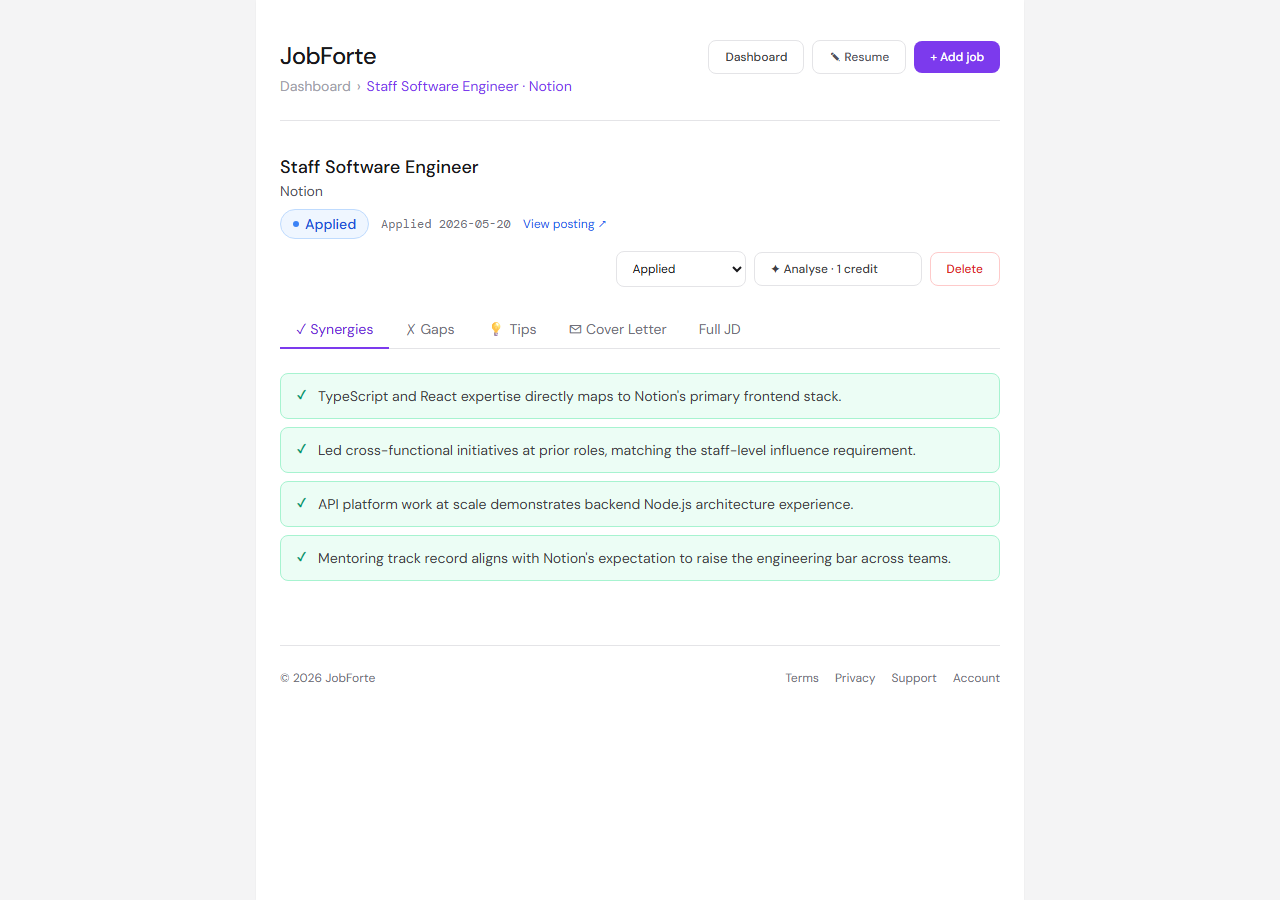
Synergies: where the resume already matches the job description, named specifically.
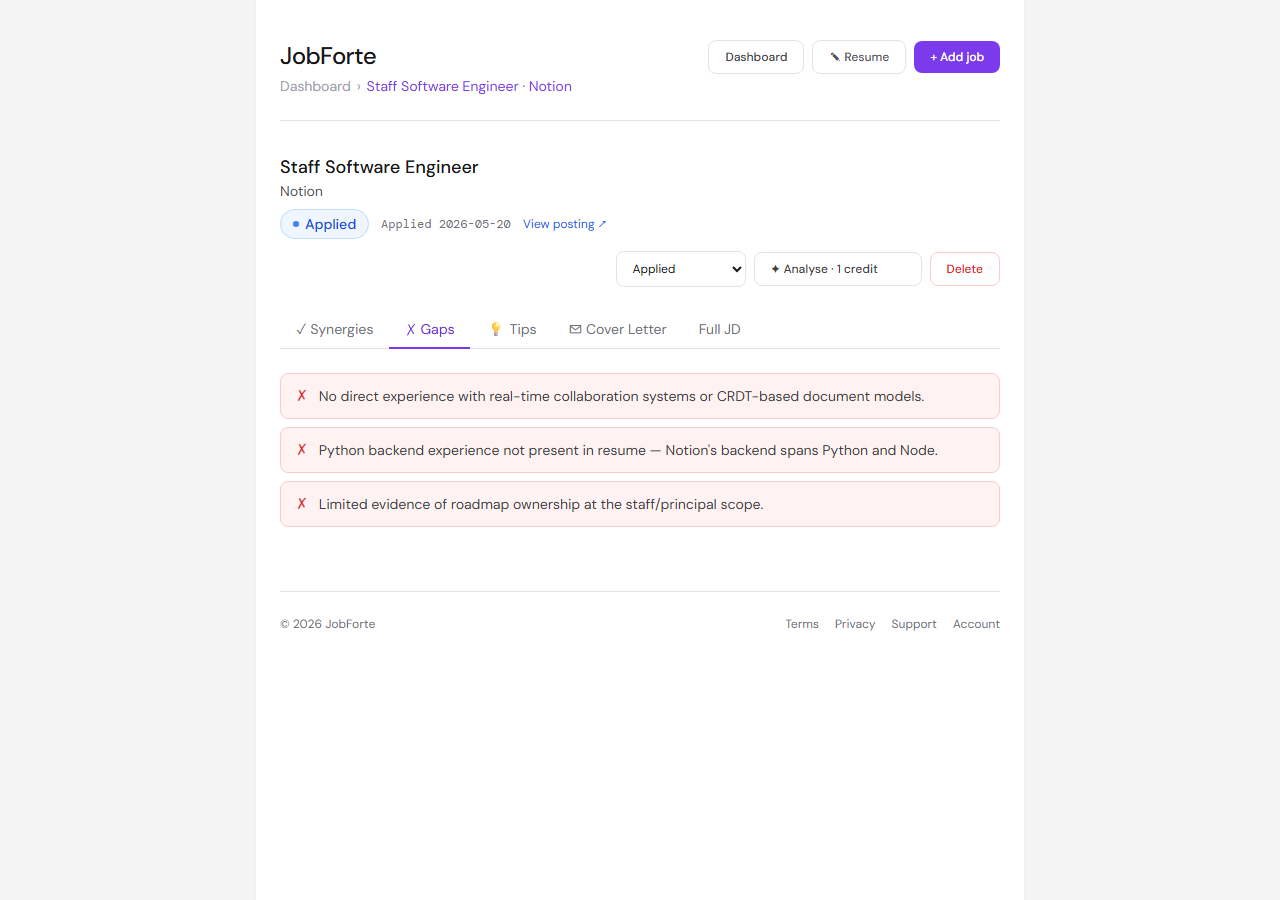
Gaps: what the posting asks for that the resume doesn't reflect yet, split from what's genuinely missing.
Questions
What ATS keywords do software engineer resumes need?
It depends entirely on the job description, which is exactly what a fixed keyword list gets wrong. A backend role screening for 'distributed systems' will flag a resume that only says 'built APIs,' even if the underlying work qualifies. Common gaps: naming the specific languages, frameworks, and cloud platforms used (not just 'full-stack'), quantified system scale (requests/sec, data volume, uptime), and explicit ownership language ('designed,' 'led,' 'owned') instead of 'contributed to' or 'helped with.'
Does JobForte check for specific languages and frameworks?
Yes, but relative to the job description you paste in, not a static checklist. If the posting requires TypeScript and your resume only lists JavaScript, JobForte flags it as a gap and tells you whether it's a real skill gap or just a wording issue.
How do I show system design experience if I haven't had the title?
This is one of the most common gaps JobForte surfaces: engineers who've done real design work (choosing a data model, scaling a service, making a build-vs-buy call) but described it as implementation ('built the checkout service') instead of design ('designed the checkout service's data model to handle 10x order volume'). The analysis flags where this kind of undersold language is costing you a match against a job description that explicitly screens for design ownership.
Should a software engineer resume have a separate skills section?
Yes. A short skills block (languages, frameworks, data stores, cloud and tooling) gives a keyword screen an exact match to find. It works best as a companion to your bullets, not a replacement: a technology listed in skills but never shown in a bullet reads as something you touched once, so the stack a posting leads with should also appear in the work where you used it.
Do side projects and open source count on an engineering resume?
They count when they cover something the posting asks for that your paid work doesn't. A side project in Go matters for a Go role if your day job is Java; a tenth React project on top of three years of production React adds little. Describe them the same way as paid work: what you built, the stack, and one concrete result like users, stars, or a merged upstream contribution.
Other roles
Checking a resume for a different role?
One free credit included · Packs from $3.99 · No subscription