ATS resume checker for project managers.
Project manager resumes get screened out over unnamed methodology and ownership: "coordinated projects" instead of the framework and the scope a posting screens for. JobForte cross-references your resume against the actual posting and shows you where that's happening.
Check your resume →What gets missed
The gaps ATS screens flag most on project manager resumes.
- Named methodology. "Project coordination" doesn't match a posting that screens for "Agile" or "Scrum" by name.
- Budget, timeline, and scope ownership. "Assisted with delivery" vs. "owned delivery of a $1.2M, 9-month program" changes whether a screen for accountability matches.
- Named tools. Jira, Asana, MS Project, Smartsheet: often used daily but unnamed on the resume.
- Stakeholder and risk language. Postings that mention stakeholder management or risk mitigation screen for those words explicitly, not just "kept projects on track."
- Certifications. PMP, CSM, or PRINCE2, when held, are frequently screened for by title-matching systems and worth stating explicitly.
How screening works
Who reads a project manager resume, and in what order.
Project manager applications usually meet the applicant tracking system first, and its main job is making your resume findable. Recruiters search the pool for the methodology, the certification, and the tools named in the posting. A resume that describes years of sprint planning without ever writing "Scrum" or "Agile" can simply fail to come back from that search.
The recruiter reads next, quickly, and looks for three signals: the methodology the team runs, whether you hold the credential the posting prefers (PMP for many traditional and enterprise roles, a Scrum certification for Agile teams), and the size of what you have managed. Project titles vary so much between companies that recruiters lean on scope instead: budget, team size, duration, and how many groups were involved.
The hiring manager reads last and reads for judgment. They want to see a trade-off you made, a risk you caught, or a stakeholder conflict you resolved, because that is the job. A strong project manager resume names the framework for the search, states the scope for the recruiter, and shows one real decision per bullet for the hiring manager.
Before and after
Three project manager bullets, rewritten against a real requirement.
Each example starts from a requirement as it typically appears in a posting. The experience behind the bullet doesn't change, only how precisely it's described.
The posting asks forProven ownership of project budget, schedule, and scope for multi-team initiatives
BeforeCoordinated a system upgrade project across several departments.
AfterOwned delivery of a $1.4M ERP upgrade across finance, operations, and IT (4 teams, 22 people), closing on budget and three weeks ahead of an 11-month schedule.
The posting screens for ownership of three specific things. "Coordinated" names none of them and reads as a support role, even when the candidate was running the project.
The posting asks forExperience running Agile ceremonies; Jira proficiency; Scrum certification preferred
BeforeRan team meetings and tracked tasks for the development team.
AfterServed as Scrum Master (CSM) for two product squads, running sprint planning, daily standups, and retrospectives in Jira; lifted sprint commitment reliability from 60% to 85% over two quarters.
"Team meetings" and "tracked tasks" describe Scrum work without any of the words a recruiter will search for: the ceremony names, the tool, and the certification.
The posting asks forStrong stakeholder management and risk mitigation
BeforeKept stakeholders updated and made sure projects stayed on track.
AfterMaintained the risk register and ran biweekly steering updates for a VP-level sponsor group; flagged a vendor delivery slip six weeks early and renegotiated scope to protect the launch date.
Postings that name stakeholder management and risk mitigation screen for evidence of both. The rewrite shows who the stakeholders were and one risk that was actually handled.
Only claim numbers you can defend in an interview. If you don't have exact figures, an honest statement of scope ("a 5-month rollout across three regional offices") still beats no scope at all.
See it in action
A real analysis for a project manager role.
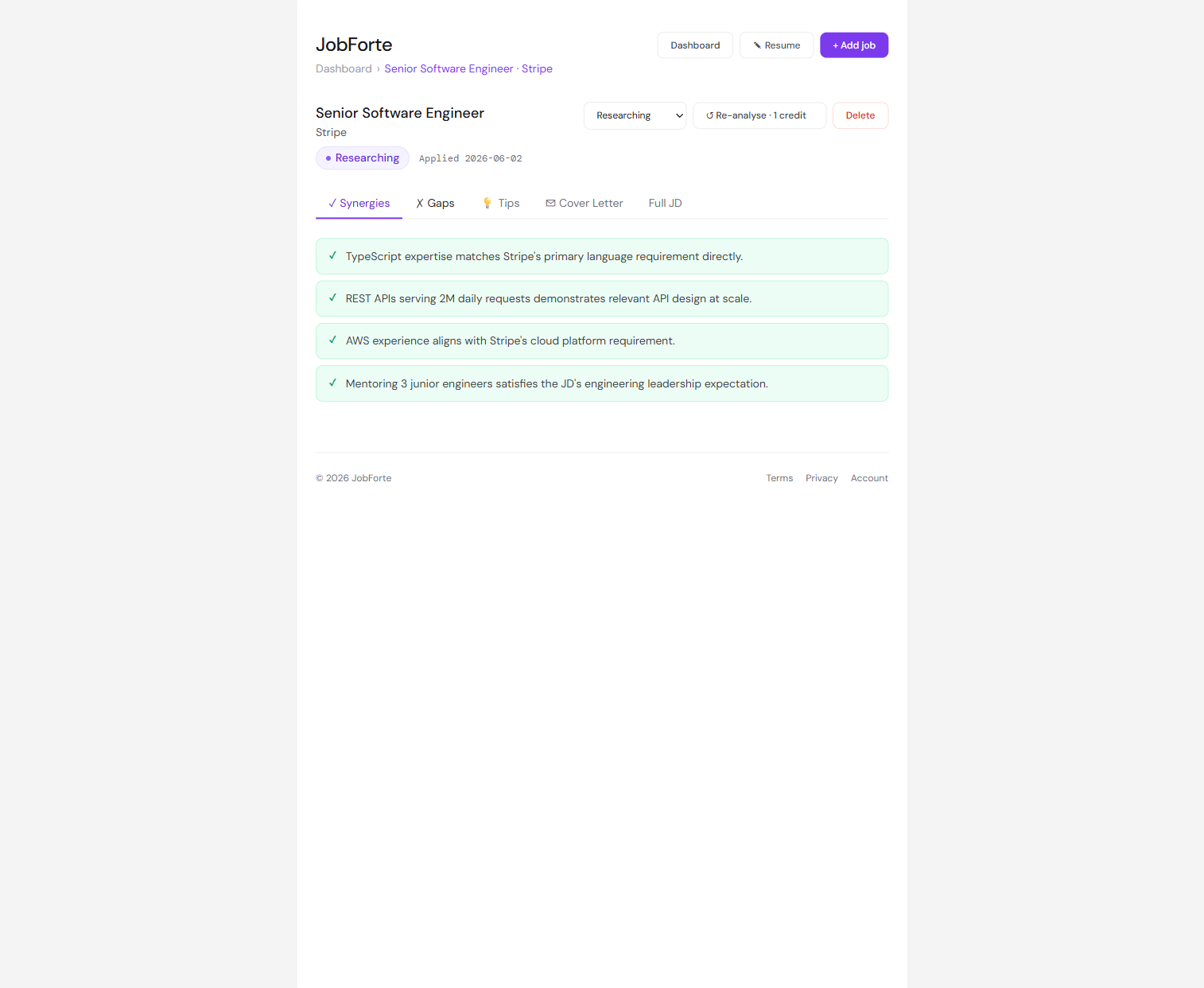
Synergies: where the resume already matches the job description, named specifically.
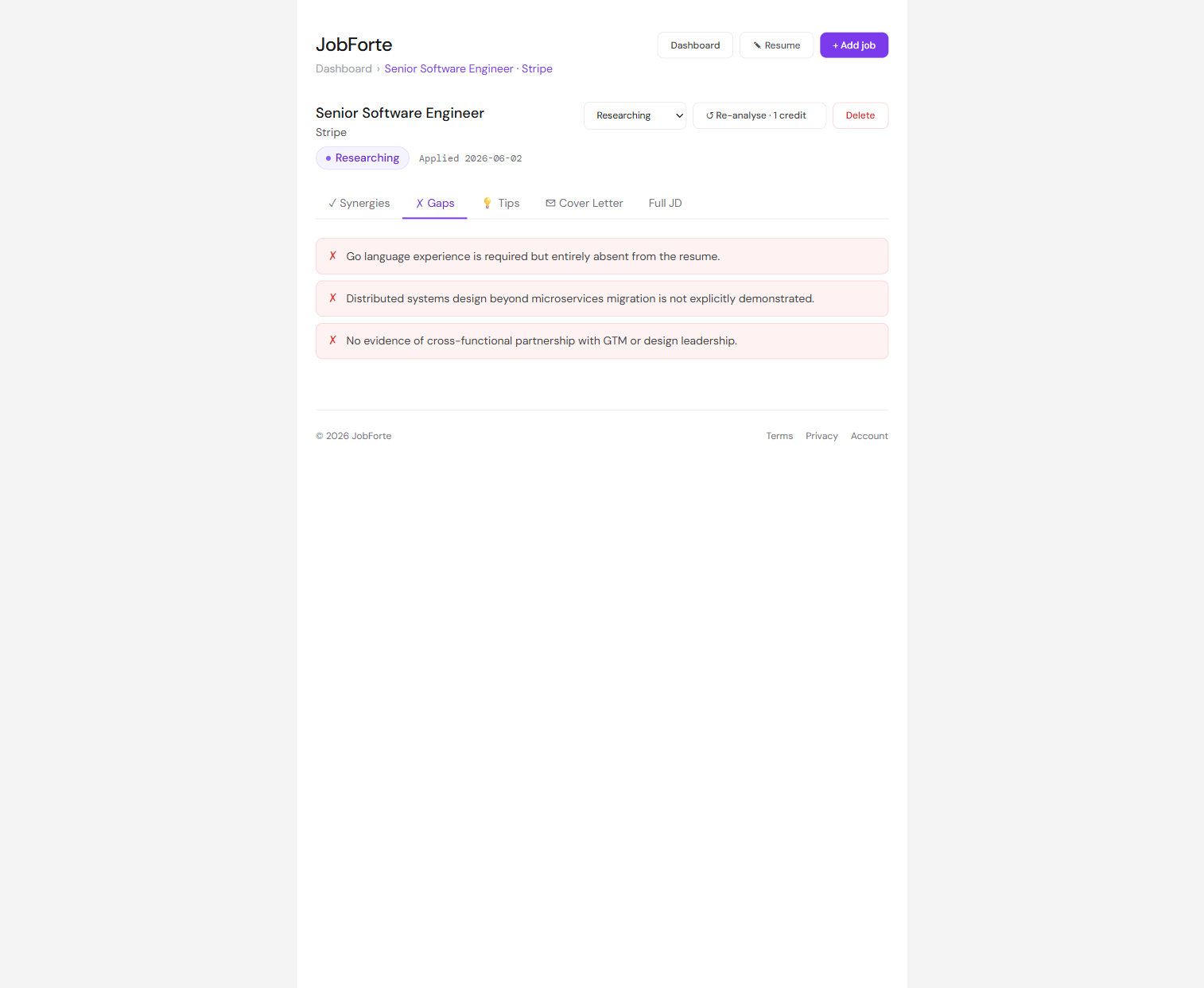
Gaps: what the posting asks for that the resume doesn't reflect yet, split from what's genuinely missing.
Questions
What ATS keywords do project manager resumes need?
Screens tend to look for named methodology (Agile, Scrum, Waterfall, PMP), named tools (Jira, Asana, MS Project, Smartsheet), and explicit ownership of budget, timeline, and scope. A resume that says "coordinated projects" without the methodology or the scope it covered is the most common gap.
How do I show project impact without exact budget figures?
Scope and outcome still transfer without a dollar figure: "delivered a 6-month, 12-person cross-functional project two weeks ahead of schedule" screens as strongly as a budget number when a posting asks for delivery track record. JobForte flags where a posting screens for scope or timeline ownership and your resume describes the work without either.
Does this work for both Agile/Scrum and traditional PMP-style roles?
Yes. The analysis is generated from the specific job description you paste in, so a posting screening for sprint planning and backlog ownership surfaces different gaps than one screening for Gantt charts, risk registers, and formal change control.
Where should PMP or other certifications go on a project manager resume?
Put them in two places: after your name in the header ("Jordan Lee, PMP") and in a dedicated certifications section with the issuing body, such as the Project Management Institute for PMP and CAPM, Scrum Alliance for CSM, or Scrum.org for PSM. Recruiters often filter a search by the certification name alone, so spell it out at least once instead of relying on the acronym, and only list credentials that are current.
How do I move from project coordinator to project manager on paper?
Separate what you tracked from what you owned. Coordinator resumes tend to describe support work ("maintained the project schedule"), while manager postings screen for decisions: scope trade-offs, escalations you ran, vendors you managed, or a workstream you delivered end to end. If you led even one of those, describe it with its scope and outcome. A CAPM can also help signal formal grounding while you build toward the PMP experience requirement.
Other roles
Checking a resume for a different role?
One free credit included · Packs from $3.99 · No subscription